The conclusion of a season calls for a programme of exceptional scale. We therefore bring the 79th artistic season to a close with a concert in which the Szczecin Philharmonic Symphony Orchestra performs two monumental masterpieces of the early twentieth century. Like Szczecin itself, the stories behind both works are inseparably connected with the sea.
Sergei Rachmaninoff composed his Piano Concerto No. 3 in D minor during the summer of 1909 at Ivanovka, his family estate. He was preparing for his first tour of the United States and needed a work that would introduce him to American audiences not only as a composer but also as one of the greatest pianists of his generation. He completed the score shortly before his departure. Having had little time to master its formidable solo part, he practised throughout the Atlantic crossing on a silent keyboard that he had brought aboard the ship.
In Szczecin, the concerto will be performed by the Ukrainian-born Australian pianist Alexander Gavrylyuk, who made his orchestral debut at the age of nine. He is the winner of the First Prize and Gold Medal at the Vladimir Horowitz International Piano Competition in Kyiv, First Prize at the Hamamatsu International Piano Competition, and the Gold Medal at the Arthur Rubinstein International Piano Master Competition in Tel Aviv.
The second half of the evening fills the Philharmonic's Golden Hall with the music of the sea. In a city whose landscape and identity have long been shaped by water, Alexander Zemlinsky's The Mermaid (Die Seejungfrau) will unfold – a richly orchestrated symphonic poem inspired by Hans Christian Andersen's fairy tale. Through music, the orchestra tells the story of the underwater kingdom, a raging storm, a rescued prince, and the mermaid who is willing to abandon her very nature for the sake of love. Zemlinsky evokes the movement of the waves, the shimmering palace beneath the sea, and the heroine's emotional journey through an orchestra of extraordinary colour and brilliance.
Behind this fairy tale lay a deeply personal story. Zemlinsky began composing the work shortly after the end of his relationship with Alma Schindler, who left him for Gustav Mahler. The manuscript was later divided: one part remained in Europe, while Zemlinsky took the others with him when he fled the Nazis for the United States in 1938. For decades, The Mermaid was believed to have been lost. Only in the early 1980s did musicologists realise that manuscripts preserved separately in Vienna and the United States belonged to the same work. Once reunited, The Mermaid returned to the concert stage in 1984.
Under the baton of Przemysław Neumann, the final concert of the season brings together Rachmaninoff's legendary pianistic tour de force and Zemlinsky's evocative tale of the sea, love, and a masterpiece restored after decades of silence. It is difficult to imagine a more fitting conclusion for Szczecin: a great symphony orchestra, a piano concerto shaped by a transatlantic voyage, and The Mermaid performed in a city that has always looked towards the sea.
DETAILS
Finale of the 79th Artistic Season
18-06-2027 19:00 | 19-06-2027 19:00
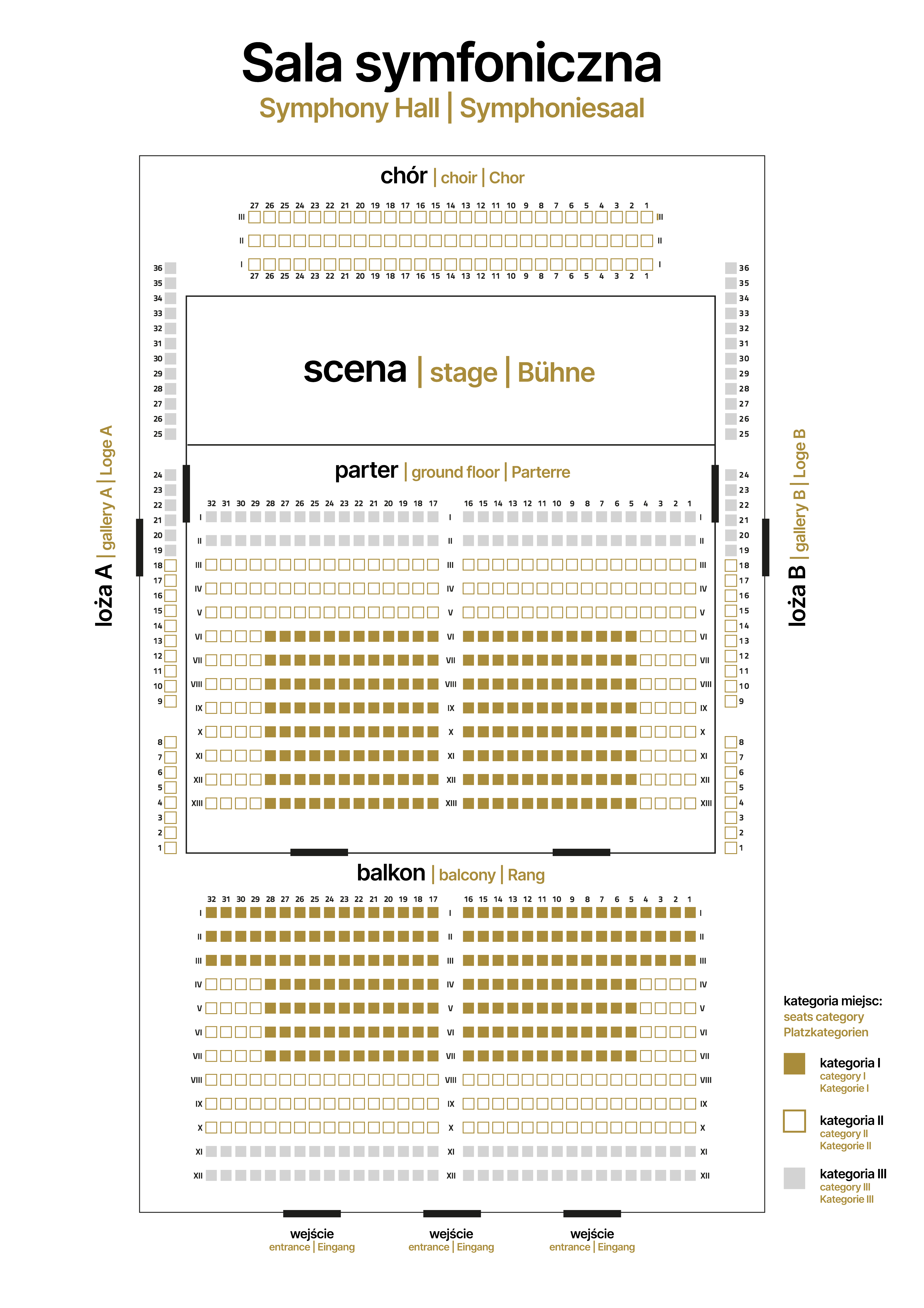
Symphony HallFilharmonia im. Mieczysława Karłowicza w Szczecinie
ul. Małopolska 48
70-515 Szczecin