Romanticism at its finest: Schumann, Dvořák, and Brahms-three giants of the symphonic repertoire, whose music allows the orchestra to reveal its full richness of colour, dynamic range, and emotional depth. It is with music such as this that our Philharmonic and its Golden Hall truly shine.
The soloist of the evening is Maria Ioudenitch, the violinist who, in 2021, won first prizes at three major international competitions: the Eugène Ysaÿe International Competition in Liège, the Tibor Varga International Violin Competition in Sion, and the Joseph Joachim International Violin Competition in Hanover. Her debut album, Songbird, recorded with pianist Kenny Broberg, received the Opus Klassik Award, and she has since appeared with many of Europe's and America's leading orchestras.
The Szczecin Philharmonic Symphony Orchestra will be conducted by Róbert Farkas, a Hungarian-German conductor who studied in Budapest and Berlin. For seven years, he served as assistant to Iván Fischer, working with both the Konzerthausorchester Berlin and the Budapest Festival Orchestra. From 2021 to 2026, he was Chief Conductor of the MÁV Symphony Orchestra in Budapest, and in 2026 he was named Conductor of the Year by Bartók Rádió.
Dvořák began work on his Violin Concerto in 1879, shortly after the extraordinary success of the first series of Slavonic Dances, which brought the previously little-known Czech composer international recognition. The concerto was intended for Joseph Joachim, one of the greatest violinists of the age, Director of the Berlin Hochschule für Musik, and a close friend of Brahms. Their collaboration continued over several years: Joachim suggested revisions, Dvořák reworked the score, and travelled repeatedly to Berlin so that they could play through the work together. Despite the dedication, Joachim never performed the concerto in public. Its premiere eventually took place in Prague on 14 October 1883, with František Ondříček as soloist. He later included the concerto in his European tours, helping to establish it in the international repertoire.
When Brahms arrived in Wiesbaden in the summer of 1883, he was already recognised as one of Europe's foremost composers. He generally spent the winter months touring as a pianist and conductor, reserving the summer for composition. This time he rented an apartment in the spa town and, working in complete secrecy, composed what he later affectionately referred to as his "Wiesbaden Symphony" – his Symphony No. 3. The premiere was a success despite attempts by some supporters of Wagner, then aligned with the opposing musical camp, to disrupt the performance. Conductor Hans Richter hailed the work as "Brahms's Eroica," while the influential critic Eduard Hanslick described it as the most artistically perfect of the composer's first three symphonies. Audiences thus encountered a work that was recognised from the moment of its premiere as one of Brahms's greatest achievements – and one that remains a cornerstone of the symphonic repertoire to this day.
DETAILS
Interweavings
07-05-2027 19:00
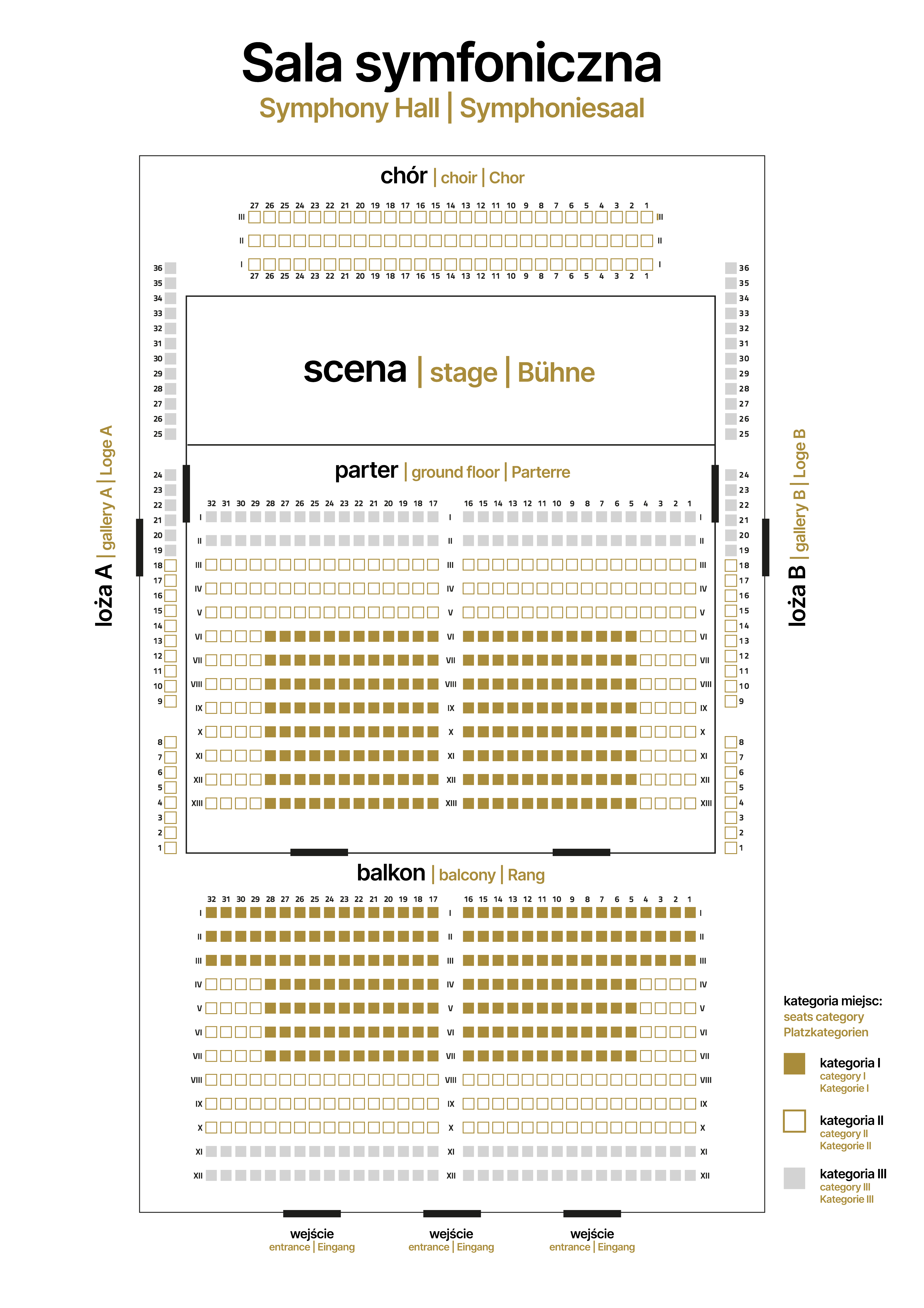
Symphony HallFilharmonia im. Mieczysława Karłowicza w Szczecinie
ul. Małopolska 48
70-515 Szczecin