For the first concert of this season’s FilHERmonia series, our Symphony Orchestra will be joined on stage by Korean cellist Sul Yoon, prizewinner of the Queen Elisabeth Competition, and German conductor Katharina Morin, winner of the Deutscher Preis. But before we applaud their musical achievements, let us take a moment to reflect on the history behind FilHERmonia itself.
The path that led women onto the concert stage began with a struggle for the right to be recognised as public artists at all. As early as the seventeenth and eighteenth centuries, exceptional figures emerged, such as Élisabeth-Claude Jacquet de la Guerre (1665-1729), the French harpsichordist, organist, and composer remembered as the first woman to compose an opera in France, and Maria Theresia von Paradis (1759-1824), the Viennese pianist who was celebrated throughout Europe. Yet for a long time, female virtuosity remained on the margins of official musical life, confined to courts, salons, or treated as an exception that merely proved the rule.
A true breakthrough came only in the nineteenth century, when the public concert became the centre of musical culture. By 1835, Clara Schumann (1819-1896) had already established a reputation throughout Europe, and in 1838 she was honoured by the Austrian court and admitted to Vienna’s Gesellschaft der Musikfreunde. Despite raising eight children and bearing the responsibilities of family life, she continued to maintain an intensive performing career. Alongside her emerged a generation of women who challenged the notion that certain instruments were “unsuitable” for them: Camilla Urso (1842-1902), who overcame scepticism toward the violin as a supposedly “masculine” instrument, and Maud Powell (1868-1920), regarded on both sides of the Atlantic as one of the finest violinists of her era.
The road to the conductor’s podium proved even steeper, as conducting was long regarded not merely as a male profession but as a symbol of institutional authority in music. This is why certain dates are so significant. On 5 November 1887, Mary Wurm, a student of Clara Schumann, became the first woman to appear on the podium of the Berlin Philharmonic. In 1923, Eva Brunelli became the first woman to conduct the orchestra in a full concert programme. In 1938, Nadia Boulanger became the first woman to conduct a subscription concert of the New York Philharmonic.
Despite these achievements, musical institutions changed painfully slowly. Madeleine Carruzzo became the first woman admitted to the Berlin Philharmonic only in 1982, while the Vienna Philharmonic accepted its first female member, harpist Anna Lelkes, as late as 1997.
Today, the situation is very different, but the story is not yet complete. When Marin Alsop became the first woman to conduct the Last Night of the Proms in 2013, the Royal Albert Hall rightly regarded it as a historic occasion. Alsop herself remarked with irony that by 2013, there should no longer have been such “firsts.” As recently as the 2021/2022 season, the Metropolitan Opera highlighted the fact that five women conducting in a single season represented the highest number in the company’s history. And we are speaking here of institutions that have long set the standard for the musical world.
Promoting female soloists and conductors is therefore not a matter of special treatment but of restoring balance between talent and visibility, between competence and access to the stage. In other words, the history of women in music is the story of a long journey toward a moment when a female artist no longer has to be a sensation. It is enough that she is outstanding.
DETAILS
PhilHERrmonic | Morning in the Big City
09-10-2026 19:00
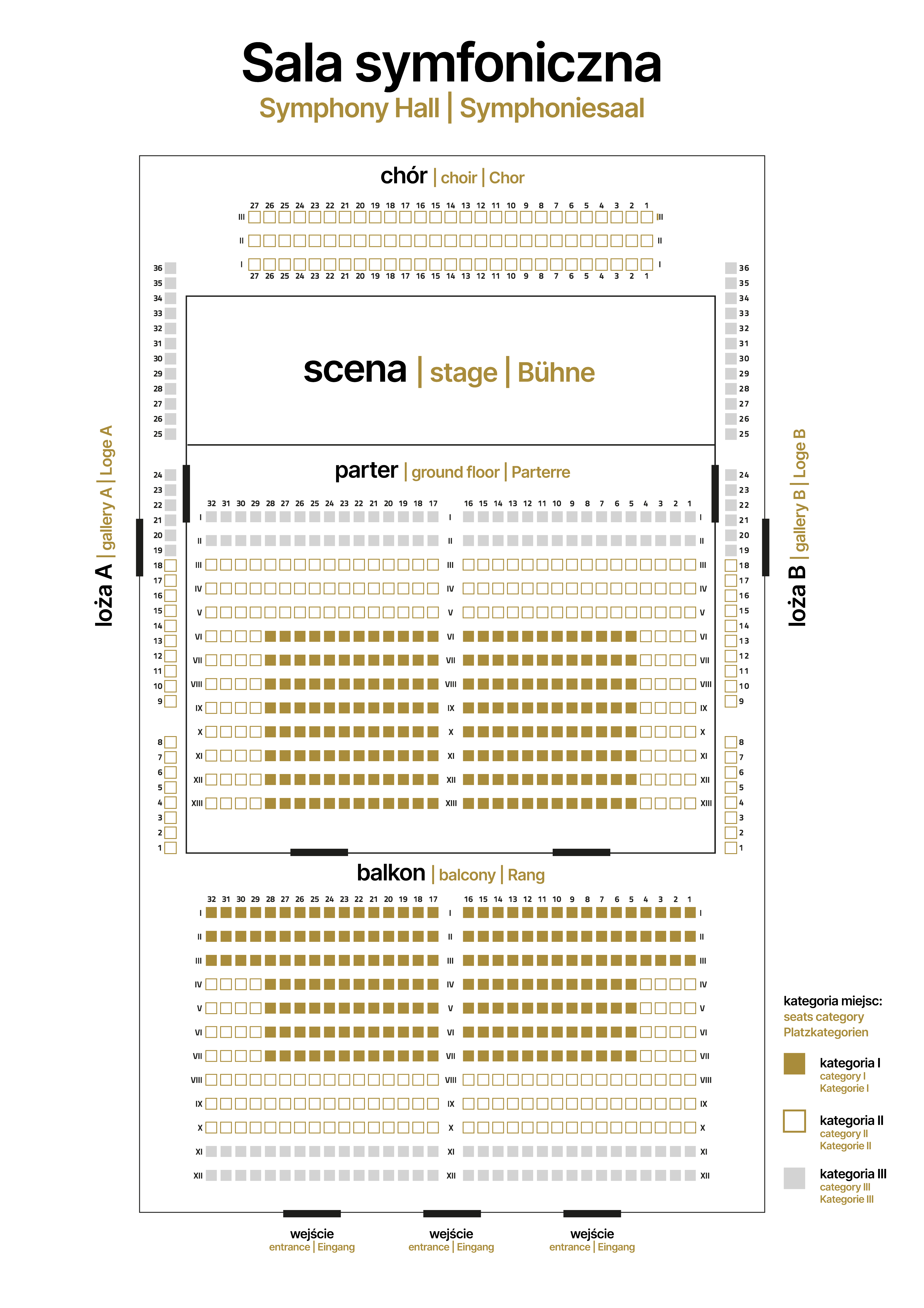
Symphony HallFilharmonia im. Mieczysława Karłowicza w Szczecinie
ul. Małopolska 48
70-515 Szczecin